According to "The Encyclopedia of Jewish Life before and during the Holocaust", the first Jews settled down in Annopol as early as in the seventeenth century. A census taken in 1764 quoted the figure of 136 Jews in the town and 37 in neighbouring villages. It is also known that in 1787 the town was inhabited by 106 Jews who accounted for 44% of Annopol's total population.
Some sources claim that here lived tzaddik Meshulam Zushia of Anipoli, the student of Dov Ber of Mezerich and Shmelke Horovitz, the brother of well-known Elimelech of Lizhensk, who inspired many Jewish folk stories. Perhaps it is misunderstanding. While it is known that Zushia of Anipoli did teach in the Lubelskie region, neither "The Encyclopaedia of Jewish Life....." nor " Memorial Book of Annopol" [Księga Pamięci Annopola] , mention his presence in the town. Perhaps what is meant is other town of the same name, in the Ostrowski district, near Wołyń.
The nineteenth century saw the prosperity of Jewish community. Annopol evolved into a Torah studying centre where the position of rabbi was held by subsequent members of the Rubinstein family: Nachman Rubinstein (1828-1878), Elimelech Rubinstein (1878-1923) and Nachman Baruch Rubinstein. In the town, there were two synagogues made of wood and stone. Wacław Flisiński, the author of "Wspominki rachowskie", writes that "The vast majority of the inhabitants were Jews. They earned their living by trade and craft as well as leased estates, salt storehouses, fruit orchards and few of them provided brokerage services and lent money on usury to the landed gentry and peasants at a high interest rate. All inns, both in the town and in the vicinity, were leased by the Jews".
Despite harsh economic conditions at the turn of the nineteenth century, the Jewish population in Annopol was numerous and counting. The population of 575 in 1897 grew to 1,251 in 1921 that accounted for 72.9% of Annopol's total population.
After the town was seized by the Nazis, a ghetto was established and the inmates were subject to cruel repressions. In May 1942, 1,943 people, among them many Jews from other towns, were placed in the ghetto. In October 1942, upon selection, nearly four hundred inmates were transported to labour camps in Gościeradów and Janiszów. Other were deported to Kraśnik on 15 October 1942 to be killed in gas chambers in Bełżec in November 1942.
The Jews set up two cemeteries in Annopol. One of them was located near the synagogue at Świeciechowska Street. It was opened until 1792 when the authorities ordered to relocate all the cemeteries out of town for sanitary reasons. All the matzevas were demolished and the area was redeveloped for other purposes.
A new cemetery was set up quite near the old one, at Radomska Street, on the rectangular area of 0.33ha. Wacław Flisiński wrote: "the new Jewish cemetery in Annopol was set up in the field, outside the town, between buildings at Bóżnicza Street and the grove in Rachów". The new cemetery was demolished during and after WWII.
Little is known about the history of the new cemetery. "The Annopol Memorial Book" provides a story dated back to the end of the nineteenth century: "In 1895 a plague broke out in Rachov and its environs. (....) The community leaders gathered in the Rabbi's home and decided to do something which (according to a belief then prevalent) would ward off the danger: to marry off two impoverished young people, in the cemetery. The two, the son of Saneh the fisherman and the daughter of the cemetery caretaker, were married in the new cemetery. All the Jews in town were there. After the ceremony, everyone went to the market place, where a sumptuous "cocktail party" had been set up, with whisky and delicacies. The people ate and drank and enjoyed themselves; even the abstainers partook freely. Shortly afterwards the plague was gone".
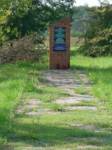
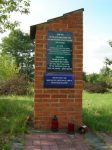
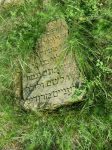
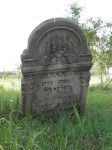
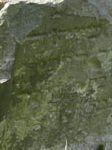
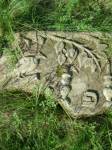
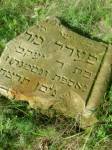
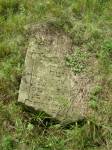
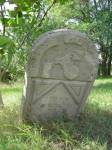
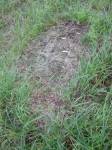
The cemetery has been recently restored. It was cleaned and fenced off with wire netting. A modest monument was erected to commemorate the Shoah victims. The brick pillar carries the plaque with the following inscription: "In honour of men, women and children from Annopol who were murdered during the second world war". Some matzevas and their remnants can be found grown over by the grass. The cemetery is placed on the list of vintage buildings under no. 408/89.
text: K. Bielawski
translation: Małgorzata Ławer
photos: Jacques Lahitte
Bibliography:
"The Encyclopedia of Jewish Life before and during the Holocaust"
W. Flisiński "Wspominki rachowskie"
M. Buber "Opowieści chasydów"
A. Trzciński "Śladami zabytków kultury żydowskiej na Lubelszczyźnie"
M. Florek "Zabytkowe cmentarze i mogiły w Polsce. Województwo tarnobrzeskie"
"Rachov-Annopol; Pirkei Edut Ve-Zikaron"